


Shockwave Therapy for Plantar Fasciitis in Brea

Your first few steps out of bed are painful. Your heel loosens slightly as you move, but the discomfort returns after standing, walking, running, or working on your feet.
You may have already tried stretching, changing shoes, using inserts, icing, massage, or temporarily reducing activity. These approaches help many people, but persistent plantar-fasciitis symptoms can be frustrating.
At Reborn Chiropractic & Wellness Center in Brea, Dr. Peter Yi offers EMS DolorClast radial shockwave therapy as one potential non-surgical treatment for appropriately selected patients with chronic heel pain.
Shockwave therapy is not a guaranteed cure, and it should not replace a proper examination. It is generally most useful as part of a broader plan that addresses mobility, strength, footwear, activity demands, and gradual return to loading.
What Is Plantar Fasciitis?
The plantar fascia is a strong band of connective tissue that runs along the bottom of the foot and helps support the arch.
Plantar fasciitis, also commonly referred to as plantar fasciopathy, usually causes pain near the inner portion of the heel.
Typical symptoms include:
Heel pain during the first steps in the morning
Pain after sitting or resting
Discomfort after prolonged standing
Pain after walking or running
Tenderness near the bottom or inside of the heel
Tightness through the calf or Achilles region
Plantar fasciitis is commonly treated conservatively, and the majority of patients improve without surgery.
However, not every case of heel pain is caused by the plantar fascia.
Other potential causes include:
Heel-fat-pad irritation
Calcaneal stress fracture
Nerve entrapment
Achilles tendon problems
Arthritis
Referred pain
Inflammatory conditions
Infection
A proper evaluation helps determine whether shockwave therapy is appropriate.
Why Can Heel Pain Become Persistent?
Persistent plantar-fascia pain is not always caused by one isolated factor.
Possible contributors include:
A sudden increase in walking or running
Long hours standing on hard surfaces
Limited ankle mobility
Tight calf muscles
Reduced foot or calf strength
Unsupportive or worn footwear
Changes in body weight
Returning to exercise too quickly
Repeated aggravation without enough recovery
Rest may temporarily reduce pain, but complete rest does not improve the foot’s capacity to tolerate work, walking, running, or exercise.
The goal is to calm the irritated tissue while gradually rebuilding its ability to handle appropriate load.
What Is Radial Shockwave Therapy?
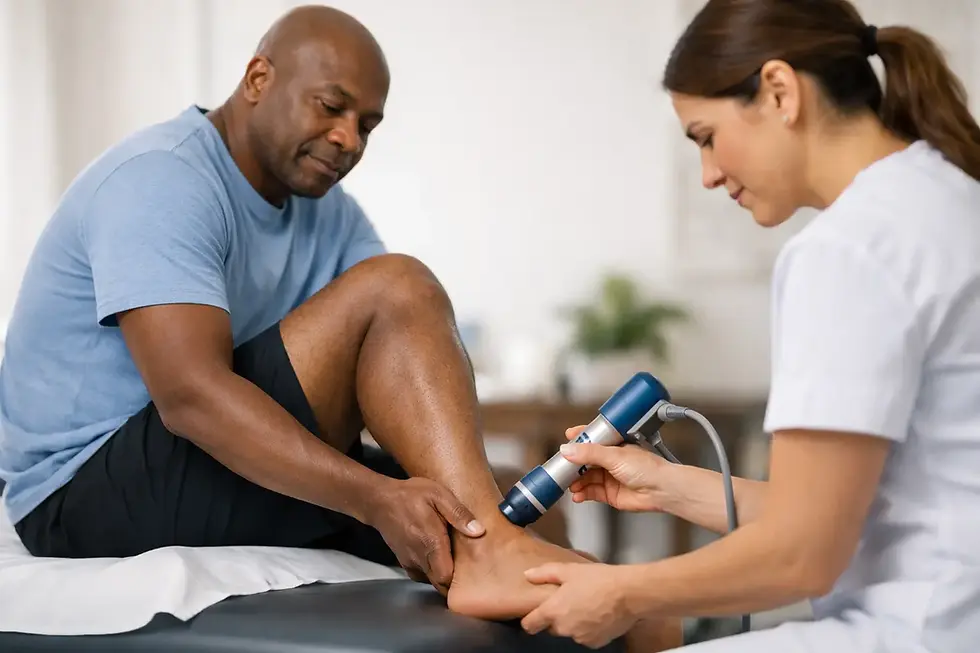
Radial shockwave therapy uses a handheld applicator to deliver repeated mechanical pressure waves into a targeted area.
At Reborn, we use the EMS DolorClast radial shockwave system.
During treatment, the applicator is placed over the affected tissue. The clinician adjusts the pressure, frequency, treatment area, and intensity according to the patient’s condition and tolerance.
Radial shockwave is not an electrical shock.
It does not send electricity through your foot. Instead, the applicator generates mechanical pressure pulses that travel into the targeted superficial tissues.
How May Shockwave Therapy Help?
The precise biological effects of shockwave therapy continue to be studied.
Proposed treatment goals include:
Reducing local pain sensitivity
Improving tolerance for standing and walking
Stimulating a local tissue response
Supporting circulation in the treated area
Reducing tenderness
Helping the patient participate more comfortably in rehabilitation
Research on extracorporeal shockwave therapy for plantar fasciopathy has produced mixed but generally supportive findings, depending on the comparison treatment, protocol, and outcome measured.
A 2024 systematic review reported that shockwave therapy may improve pain in plantar fasciopathy, but treatment protocols differed significantly.
Another 2024 meta-analysis found improvements in pain and foot function compared with corticosteroid injections at approximately three months.
However, other reviews have found no clear pain advantage over different non-surgical treatments, and a 2026 review concluded that radial shockwave was not clearly superior to other electrophysical modalities.
The responsible conclusion is not that shockwave always works or never works. It is that it may be a reasonable non-invasive option for selected patients, particularly when paired with rehabilitation and monitored for meaningful improvement.
Why Use EMS DolorClast?
EMS DolorClast is a specialized radial shockwave platform used for musculoskeletal treatment.
However, the equipment alone does not guarantee a successful outcome.
Important clinical factors include:
An accurate working diagnosis
Appropriate patient selection
Correct applicator placement
Proper intensity
Monitoring the patient’s response
Combining treatment with active rehabilitation
At Reborn, treatment is not limited to placing the device over the painful heel.
Dr. Peter evaluates the symptom pattern, tissue tenderness, ankle mobility, activity demands, footwear, and how the patient loads the foot during standing or movement.
What Does Treatment Feel Like?
During treatment, you may feel rapid tapping or pressure over the heel and plantar fascia.
The sensation may feel:
Mildly uncomfortable
Tender over sensitive areas
More noticeable near the main pain point
More tolerable as the session progresses
The intensity can be adjusted.
More pain during treatment does not necessarily produce a better result. The goal is to deliver a clinically appropriate dose while maintaining reasonable patient comfort.
Some patients experience temporary soreness afterward, similar to post-exercise soreness.
Report significant swelling, bruising, increasing numbness, or unusual pain.
How Many Sessions Are Needed?
There is no universal number of treatments that is right for every patient.
Recommendations depend on:
How long the symptoms have been present
Pain severity
Examination findings
Activity demands
Previous treatment
Tissue sensitivity
Response to the initial sessions
Participation in rehabilitation
Shockwave protocols commonly involve a limited series rather than indefinite ongoing care.
Progress should be measured through meaningful functional changes, such as:
Less pain during the first morning steps
Improved standing tolerance
Easier walking
Reduced tenderness
Greater exercise tolerance
Fewer flare-ups
If meaningful improvement is not occurring, the diagnosis and treatment plan should be reassessed.
Shockwave Should Not Be the Only Treatment
Shockwave therapy may help reduce pain sensitivity and create an opportunity for rehabilitation, but it does not replace active care.
A comprehensive plan may include:
Plantar-Fascia and Calf Mobility
Gentle stretching may improve mobility through the plantar fascia, calf, and ankle.
Stretching should not be so aggressive that it repeatedly aggravates the heel.
Foot and Calf Strengthening
Progressive exercises may improve the ability of the foot and calf to tolerate daily and athletic demands.
Exercises may include:
Calf raises
Seated foot-strengthening exercises
Toe-control exercises
Balance activities
Gradual single-leg loading
The correct starting level depends on the patient’s current symptoms and capacity.
Footwear and Activity Guidance
Patients may temporarily need to modify:
Running volume
Walking distance
Barefoot activity
Prolonged standing
Hill training
Jumping or plyometric exercise
The goal is generally not permanent avoidance. It is to reduce repeated irritation while gradually rebuilding tolerance.
Lower-Extremity and Movement Assessment
Some patients also demonstrate mobility restrictions or compensations involving the ankle, knee, hip, or lower back.
When appropriate, care may include:
Joint mobilization or chiropractic adjustment
Soft-tissue treatment
Gait and movement guidance
This does not mean that every heel problem originates in the spine. It means that the full movement pattern should be evaluated when clinically relevant.
Who May Be a Candidate?
Radial shockwave may be considered when:
Heel pain has persisted despite basic home care
The examination supports plantar-fascia involvement
Symptoms limit standing, walking, work, or exercise
The patient prefers a non-surgical treatment option
No contraindication is present
The patient is willing to participate in rehabilitation
It may be especially reasonable for chronic symptoms that have not responded adequately to stretching, footwear changes, activity modification, or other conservative measures.
When May Shockwave Be Inappropriate?
Shockwave may not be appropriate—or may require medical clearance—when there is:
A suspected fracture
Active infection
An open wound
A significant bleeding disorder
Use of certain anticoagulant medications
Markedly impaired sensation
A tumor in the treatment region
Certain vascular conditions
Recent surgery
An unclear diagnosis
Shockwave should not be applied indiscriminately over an unhealed fracture, major nerves or blood vessels, or a treatment region where an important contraindication is present.
When Should Heel Pain Receive Medical Evaluation?
Seek prompt evaluation when heel pain is associated with:
Significant trauma
Inability to bear weight
Severe swelling
Redness or warmth
Fever
Persistent night pain
Progressive numbness
A suspected fracture
A wound that is not healing
Diabetes with new foot symptoms
A history of cancer with unexplained new pain
These findings may require imaging, podiatric care, orthopedic evaluation, or another form of medical management.
Frequently Asked Questions
Is radial shockwave painful?
It can feel uncomfortable over sensitive tissue, but the intensity can be adjusted. Treatment should remain reasonably tolerable.
Is shockwave the same as ultrasound?
No. Therapeutic ultrasound and radial shockwave use different forms of mechanical energy and different treatment methods.
Is shockwave an electrical treatment?
No. Radial shockwave delivers mechanical pressure pulses rather than electrical current.
Does shockwave break up heel spurs?
The goal is not to break a heel spur. Heel spurs are not always responsible for plantar-fasciitis pain. Treatment focuses on the symptomatic tissue and the patient’s ability to function.
Can I exercise during treatment?
Often, yes, but the activity may need to be modified. The appropriate level depends on symptom irritability, exercise type, and how the foot responds.
Does insurance cover shockwave therapy?
Coverage varies. Many insurance plans consider shockwave therapy a non-covered or cash service. Patients should verify their individual benefits.
Schedule a Plantar-Fasciitis Evaluation in Brea
Persistent heel pain can affect your first steps in the morning, your workday, your exercise routine, and your ability to stay active.
Reborn Chiropractic & Wellness Center offers EMS DolorClast radial shockwave therapy, individualized rehabilitation, and one-on-one musculoskeletal care for patients in Brea and surrounding North Orange County communities.
Our approach combines modern treatment options with careful evaluation, active rehabilitation, and realistic treatment planning.
Contact Reborn Chiropractic & Wellness Center to determine whether radial shockwave therapy may be appropriate for your heel pain.
This article is for general educational purposes and does not provide a diagnosis or replace individualized medical, orthopedic, or podiatric care.

Comments