


Tennis Elbow That Won’t Go Away: Why It Lingers and When Shockwave Therapy May Help

You do not have to play tennis to develop tennis elbow.
A patient may first notice pain while:
Carrying groceries
Picking up a coffee cup
Using a screwdriver
Lifting weights
Shaking hands
Typing and using a mouse
Playing pickleball, tennis, or golf
At first, the discomfort may seem minor.
Then weeks pass, and the outside of the elbow still hurts whenever you grip, lift, or extend the wrist.
Why does tennis elbow sometimes linger for so long?
The answer is usually more complicated than simply having an “inflamed elbow.”
Persistent lateral elbow pain often involves the common extensor tendon near the outside of the elbow and can be influenced by repeated tendon loading, strength and activity demands, and how much recovery the tissue receives between those demands.
At Reborn Chiropractic & Wellness Center in Brea, Dr. Peter Yi uses EMS DolorClast radial shockwave therapy as one conservative treatment option for appropriately selected patients with persistent tendon-related pain.
But shockwave is not the entire treatment plan.
First, it is important to understand what is actually being irritated and why it keeps returning.
What Is Tennis Elbow?
Tennis elbow is commonly called lateral epicondylitis, although lateral elbow tendinopathy is often a more accurate description of persistent cases.
The pain usually occurs near the bony prominence on the outside of the elbow where several forearm extensor tendons attach.
Symptoms may include:
Tenderness at the outside of the elbow
Pain with gripping
Pain lifting a cup or pan
Pain turning a doorknob
Discomfort shaking hands
Pain with wrist extension
Reduced grip tolerance
Pain during racquet sports
Symptoms can gradually develop rather than beginning with one obvious injury.
You Do Not Need to Play Tennis
The name can be misleading.
Any activity that repeatedly loads the wrist extensor muscles and their tendons may contribute.
That can include:
Tennis
Pickleball
Golf
Weight training
Construction work
Plumbing
Painting
Gardening
Repetitive tool use
Certain computer tasks
Repeated lifting at work
A tennis player may notice pain during backhands.
A healthcare worker may notice pain while repeatedly gripping equipment.
A new parent may notice it while carrying a child or car seat.
The important issue is not the sport.
It is how much load the tendon is being asked to tolerate.
Why Does Tennis Elbow Become Persistent?
Tendons adapt to load.
Appropriate loading can make them stronger.
But repeated demand that exceeds current tissue capacity can contribute to persistent symptoms.
Several factors may keep the cycle going.
1. Repeated Gripping Without Enough Recovery
Even if you stop playing tennis, your elbow may still be loaded throughout the day.
Consider how frequently you:
Grip a steering wheel
Use a mouse
Lift bags
Hold your phone
Carry a child
Use tools
Grip weights
A tendon may receive hundreds of small loading exposures without the patient realizing how much work the forearm is doing.
This is one reason simply avoiding the sport that originally triggered the pain may not be enough.
2. Returning to Activity as Soon as the Pain Improves
Tendon symptoms can settle before the tissue has regained full capacity for sport or work.
For example:
You rest from tennis for two weeks.
The elbow feels considerably better.
You return and immediately play three competitive sets.
The pain returns the following day.
This does not necessarily mean that all recovery was lost.
The return to load may simply have been too rapid.
A gradual progression is usually more useful.
3. Complete Rest for Too Long
Rest can temporarily reduce pain, but a tendon also needs appropriate mechanical loading to regain capacity.
If an arm is protected from meaningful activity for an extended period, it may become less prepared for:
Gripping
Lifting
Sport
Repetitive work
The eventual return to normal activity can then represent a very large jump in demand.
The goal is usually not:
Never use the painful arm.
It is:
Temporarily modify provocative loads while progressively rebuilding what the tendon can tolerate.
4. Treating Only the Painful Spot
The outside of the elbow may be where the pain is felt, but the entire upper extremity participates in gripping and lifting.
Depending on the patient, useful assessment may include:
Wrist strength
Forearm strength
Grip tolerance
Elbow mobility
Upper-back movement
Work technique
Racquet or sport demands
This does not mean that every elbow problem originates in the neck or shoulder.
It simply means that treatment should consider the demands placed on the entire arm rather than focusing exclusively on one painful point.
5. Doing the Same Aggravating Activity Every Day
Sometimes the primary issue is not lack of treatment.
It is that the tendon receives the same provoking load every day.
Examples might include:
Eight hours of repetitive tool use
Frequent heavy gripping at work
Daily racquet sports
Repetitive lifting with the wrist extended
Treatment can help, but it cannot completely overcome an activity that continuously exceeds what the tissue currently tolerates.
Temporary workload changes may be part of recovery.
How Is Tennis Elbow Evaluated?
An evaluation may include:
Location of tenderness
Pain with resisted wrist movement
Grip tolerance
Elbow range of motion
Wrist mobility
Shoulder function
Neurological screening when needed
Activities that reproduce symptoms
Not every pain near the outside of the elbow is tennis elbow.
Other possible causes can include:
Radial nerve irritation
Joint-related pain
Cervical nerve involvement
Referred pain
Significant tendon injury
Less commonly, other medical conditions
That is why treatment should follow an examination rather than simply treating every lateral-elbow complaint with shockwave.
What Is Radial Shockwave Therapy?
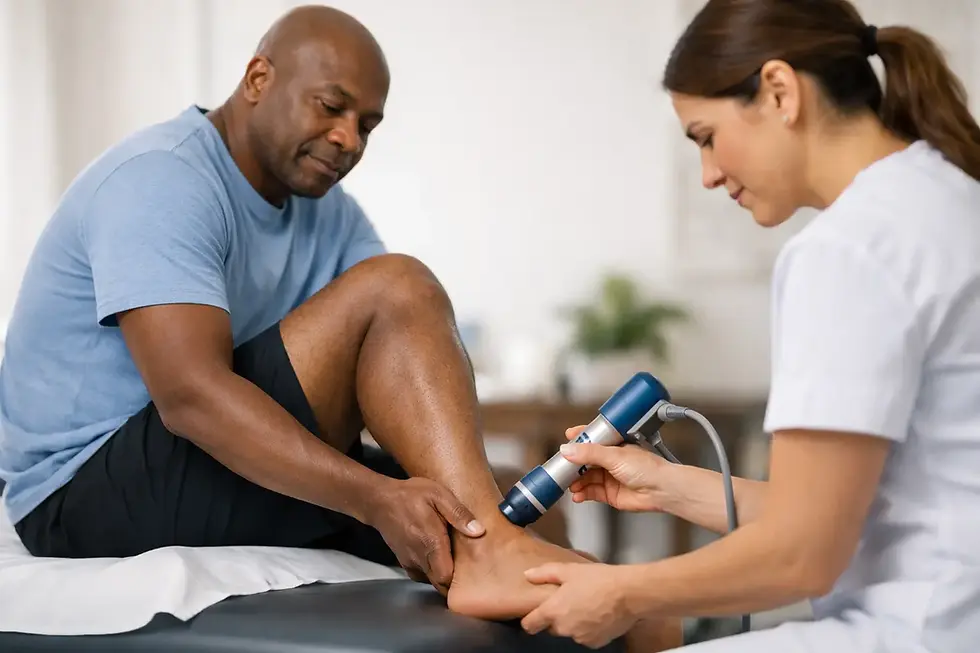
Radial shockwave therapy uses a handheld applicator that delivers repeated mechanical pressure waves into targeted soft tissue.
Despite the name, it is not an electrical shock.
At Reborn Chiropractic & Wellness Center, we use the EMS DolorClast radial shockwave system.
During treatment:
1. Gel is applied over the target area.
2. The applicator is positioned over the involved tissue.
3. Pressure waves are delivered at an individualized intensity.
4. The clinician adjusts treatment according to patient tolerance and response.
Patients often describe the sensation as rapid tapping or pulsing.
Sensitive areas may feel uncomfortable, but treatment should remain tolerable.
How Might Shockwave Help Tennis Elbow?
Shockwave therapy has been studied as a non-invasive option for persistent lateral elbow tendinopathy.
Potential goals include:
Reducing pain sensitivity
Improving tolerance for gripping and movement
Supporting a local tissue response
Helping the patient participate more comfortably in rehabilitation
Recent evidence is encouraging in some comparisons, but it is not uniformly positive.
A 2025 systematic review found ESWT produced greater pain improvement than therapeutic ultrasound, although functional superiority was less clear.
A 2024 meta-analysis comparing shockwave therapy with corticosteroid injections found injections performed better at one month, while ESWT showed better pain and functional outcomes at three to six months.
However, a more recent systematic review concluded that the overall evidence for ESWT in chronic lateral elbow tendinopathy remains inconclusive, with only some higher-quality studies showing clear benefit.
So the responsible conclusion is:
Shockwave may be a useful option for selected patients with persistent tennis-elbow symptoms, but it is not guaranteed to work and should not replace progressive rehabilitation.
Why We Use EMS DolorClast Radial Shockwave
The equipment itself is not what determines success.
At Reborn, the EMS DolorClast system gives us a dedicated radial shockwave platform, but the more important factors are:
Correct diagnosis
Appropriate patient selection
Accurate tissue targeting
Appropriate treatment intensity
Regular reassessment
Progressive rehabilitation
A shockwave machine should not simply be placed on every painful elbow.
The goal is to determine whether the presentation actually fits a condition for which radial shockwave may be reasonable.
Is Radial Shockwave the Same as Focused Shockwave?
No.
Both use mechanical acoustic energy, but they deliver it differently.
Radial shockwave disperses energy outward from the applicator and is commonly used for relatively superficial musculoskeletal tissues.
Focused shockwave concentrates energy more precisely at a selected depth.
One is not automatically superior for every condition.
At Reborn, our clinic uses radial shockwave therapy with EMS DolorClast.
That is why our treatment recommendations are based on conditions and tissues that are appropriate for the technology we actually provide.
What Does a Tennis-Elbow Shockwave Session Feel Like?
The applicator is placed over the tender tendon region while repeated pulses are delivered.
You may feel:
Rapid tapping
Pressure
Localized tenderness
Temporary sensitivity
The intensity can be adjusted.
You do not need to tolerate extreme pain for treatment to be effective.
Some patients notice mild temporary soreness afterward.
The treatment area should be monitored for unusual swelling, bruising, numbness, or significant worsening.
How Many Sessions Are Needed?
There is no universal treatment number that applies to every patient.
Recommendations may depend on:
How long the elbow has hurt
Severity
Work demands
Previous treatments
Examination findings
Response to initial treatment
Rather than assuming that every patient needs a large predetermined package, progress should be reassessed.
Useful signs include:
Less pain while gripping
Improved lifting tolerance
Less morning or post-activity soreness
Improved ability to work
Improved racquet-sport tolerance
Greater exercise capacity
If these changes are not occurring, the plan may need to change.
Why Strengthening Still Matters
Shockwave may help create a more comfortable environment for rehabilitation.
It does not replace rehabilitation.
Tendons need to regain the ability to handle load.
Depending on the stage of recovery, exercise may include:
Isometric wrist-extension exercises
Progressive wrist-extensor strengthening
Grip exercises
Forearm pronation and supination
Shoulder and upper-extremity strengthening
Gradual sport-specific loading
The correct exercise and dosage depend on the patient's irritability and goals.
An exercise should not be selected simply because it appears on a generic “tennis elbow” video.
Should You Stop Playing Tennis or Pickleball Completely?
Not always.
During a significant flare, temporarily reducing:
Playing frequency
Match duration
Intensity
Repetitive backhands
Heavy gripping
may be appropriate.
As the elbow becomes more tolerant, activity can often be progressively reintroduced.
Returning directly from complete rest to several hours of high-intensity play may reproduce the same problem.
What About a Tennis-Elbow Strap?
Some people find short-term symptom relief from a counterforce strap.
It may reduce discomfort during certain activities, but it does not rebuild tendon capacity.
A brace should therefore be viewed as an optional support rather than the entire treatment.
If the strap increases numbness, tingling, or discomfort, discontinue it and have the condition evaluated.
Should You Stretch the Forearm?
Gentle mobility may be appropriate for some patients.
Aggressive stretching is not automatically better.
If repeatedly stretching the forearm into strong pain makes the elbow more sensitive afterward, reduce the intensity.
Tendon rehabilitation is generally more than simply trying to make the forearm muscles “looser.”
When May Shockwave Not Be Appropriate?
Radial shockwave may be inappropriate or require medical clearance in situations involving:
Suspected fracture
Active infection
Open wounds
Certain bleeding disorders
Some anticoagulant situations
Significant loss of sensation
Tumor in the treatment region
Certain vascular concerns
Recent surgery
Unclear diagnosis
A complete health history is important before treatment.
When Does Elbow Pain Need Additional Evaluation?
Seek medical or orthopedic evaluation when there is:
Significant trauma
Visible deformity
Major swelling
Inability to use the arm
Progressive weakness
Persistent numbness
Fever with a hot or swollen joint
Suspected fracture
Symptoms that continue despite appropriate conservative care
Persistent elbow pain should also be reconsidered if the pattern does not behave like a typical tendon problem.
Frequently Asked Questions
Can tennis elbow happen if I do not play tennis?
Yes.
Repetitive gripping, lifting, tools, weight training, pickleball, golf, and occupational activity can all load the same forearm tendons.
Why does my tennis elbow keep coming back?
Symptoms may recur when activity demands repeatedly exceed the tendon’s current capacity, especially after a rapid return to sport or work.
Does tennis elbow mean the tendon is inflamed?
Not necessarily.
Persistent lateral elbow tendinopathy is more complex than simple ongoing inflammation, which is one reason the term tendinopathy is often preferred in chronic cases.
Can shockwave therapy cure tennis elbow?
It should not be presented as a guaranteed cure.
Research suggests potential benefit in selected patients, but the evidence remains mixed and rehabilitation is still important.
Is shockwave better than a cortisone injection?
They have different risk-benefit profiles and time courses. A 2024 meta-analysis found corticosteroid injection performed better at one month, while shockwave had better outcomes at later three- and six-month follow-up in the studies analyzed. Individual treatment decisions should be discussed with the appropriate healthcare provider.
Does shockwave hurt?
Treatment can feel tender, particularly directly over an irritated tendon, but the intensity can be adjusted to remain tolerable.
Do I still need exercises if I receive shockwave?
Usually, yes.
Shockwave may be one tool to help manage symptoms, while progressive exercise helps rebuild the tendon’s ability to tolerate gripping, lifting, work, and sport.
Tennis Elbow and Shockwave Therapy in Brea
Persistent tennis elbow can become frustrating when seemingly simple activities—gripping a cup, carrying groceries, lifting at work, or swinging a racquet—continue to hurt.
The answer is not always more rest.
And it is not always another passive treatment.
At Reborn Chiropractic & Wellness Center in Brea, Dr. Peter Yi evaluates the activities that reproduce symptoms, the demands placed on the arm, and whether radial shockwave therapy may be appropriate.
When indicated, our approach may combine:
EMS DolorClast radial shockwave therapy
Progressive therapeutic exercise
Activity modification
Mobility work
Manual treatment when appropriate
The goal is not simply to make the elbow feel better for one afternoon.
It is to improve the arm's ability to tolerate the work, exercise, and activities you want to return to.
Contact Reborn Chiropractic & Wellness Center in Brea if persistent tennis-elbow symptoms are limiting your work, workouts, tennis, pickleball, or everyday activities.
This article is for general educational purposes and does not provide a diagnosis or replace individualized medical, orthopedic, or rehabilitative care.

Comments